Helix in Practice
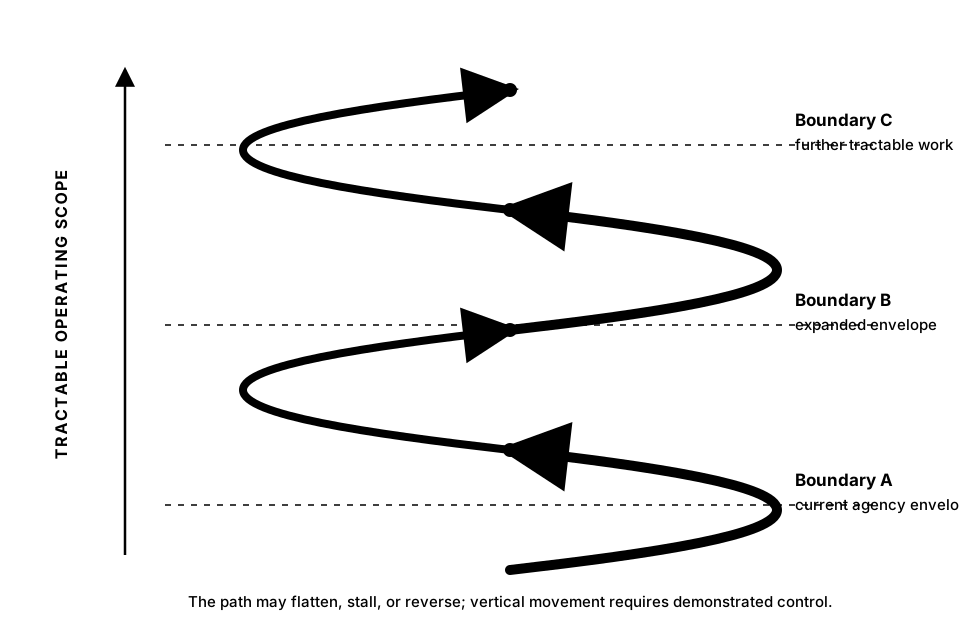
The Helix hypothesis asks whether retained operational learning makes further delegation reliable and economical across successive expansions of entrusted work or authority.
Whereas a Flywheel improves operation within the current commitment, a candidate Helix step changes that commitment. The operator's work is to specify the proposed expansion, test the controls it needs, and decide what the resulting evidence warrants.
An operational perspective#
A support system may learn to produce useful routing recommendations while people approve every action. The team may then propose allowing it to create follow-up tickets for a defined class of requests. That change adds authority even if the model, prompt, and user interface remain familiar.
I would treat the proposal as a new operating commitment. The earlier results provide a baseline and useful control assets. Ticket creation also brings new questions: duplicate actions, partial failure, downstream work, and recovery of changed state.
One successful expansion supplies local evidence. Repeated reliable expansions with reusable controls and net value bear on the stronger Helix hypothesis.
What the helix represents in practice#
The mechanism depends on what carries forward. A tested classification rule may remain useful in ticket creation; the action path still needs fresh validation. Operator knowledge may shorten investigation; changed tool semantics can make an old recovery procedure unsafe.
Before treating an expansion as a test of Helix, establish:
- a documented baseline for bounded work with measurable outcomes;
- tested local learning and records that support timely intervention;
- a named person authorized to change the boundary and a reason to pursue additional delegation;
- a specified candidate expansion, acceptance criteria, error budget, and observation period.
Then test whether retained learning actually reduces the burden of delegation. Record what was reused, what needed adaptation or rebuilding, and what revalidation and added oversight cost. Reuse produces a benefit when those savings survive the additional work; expansion can also depreciate assets that supported the earlier boundary.
Early signals of helix behavior#
Requests for adjacent work are a reason to inspect the boundary. So are users bypassing approval, downstream teams depending on outputs in new ways, or operators spending more time supervising actions they previously performed.
I have missed this transition myself. In one case, capability kept improving and nothing produced an incident. By the time we admitted that decision authority had shifted without being designed, reversing course was expensive and politically awkward. The lesson for me was less about speed and more about attention: we didn’t notice when the work changed.
Treat such changes as signals for review. Establish what is already occurring, contain any authority beyond the approved commitment, and assess the proposed new boundary explicitly. Usage and organizational enthusiasm help identify demand; reliability and economics need their own observations.
Structural shifts operators must manage#
Start an expansion review with the current and proposed commitments side by side. Use the agency-envelope checklist to identify changed permissions, horizon, state, delegation/concurrency, reversibility/containment, and oversight capacity.
For each changed dimension, record the affected actions, controls, owner, and required evidence. A longer horizon with narrower permissions is a changed envelope; explain which additional work becomes tractable and how the combination changes exposure. A technical control adjustment can remain within the current commitment.
Use the Execution decision record to preserve the rationale, authorized limits, intervention conditions, and review point. Changes in risk tolerance require their own explicit decision, visible alongside the performance comparison.
Interfaces become the unit of control#
Interfaces are where authority becomes action and where downstream systems assign meaning to an output.
Operators should focus attention on:
- where authority enters the system and under whose identity;
- how outputs are interpreted and acted on downstream;
- what happens when inputs are ambiguous, tool calls partially succeed, or signals conflict;
- which effects can be isolated, reversed, or reconciled.
Test those boundaries under the proposed authority. A reliable recommendation can still produce an unreliable action path when retries duplicate work or a downstream system treats a tentative output as final.
Human work and decision rights#
Delegation changes the distribution of work. Name the execution, supervision, exception handling, and recovery tasks that remain, and the people who will perform them.
Record that effort in total and per comparable outcome. More valuable or more extensive work can justify greater total supervision. A system remains dependent on that capacity even when ordinary actions appear automatic.
Confirm that reviewers can inspect the evidence and act within the required time at the proposed volume and concurrency. If the queue exceeds their capacity, reduce the action rate, narrow the cases, add capacity, or return the affected action to approval before expanding further.
Containing momentum#
Set stop and contraction conditions before the trial begins. Name the action paths to pause, the owner who can pause them, the treatment of in-flight work, and the baseline to restore.
At the agreed review point, compare reliability against the previously stated error limits with severity, exposure, task mix, and observation period visible. Assess value after the full costs of integration, adaptation, revalidation, supervision, infrastructure, governance, and failure. The Scaling chapter develops that comparison.
Record unsuccessful, stalled, and abandoned attempts alongside successful ones. Loss of an entry condition can justify contraction and limits where the mechanism applies. Across eligible workflows, persistently bespoke integration that keeps delegation prohibitively costly, repeated breaches of error limits despite functioning evaluation and intervention, or failure to produce net value despite local reliability and demand would weaken the Helix hypothesis. Where gains track model upgrades, investigate whether retained operational learning supplied a reproducible benefit.
Operator takeaways#
An expansion decision should answer:
- What additional work or authority are we entrusting, and why?
- Which entry conditions were established before the attempt?
- Which controls transferred, which were rebuilt, and what did the transfer save after full costs?
- Did reliability remain within the stated limits, with supervision and exposure visible?
- Should this boundary continue, contract, or return to a bounded trial?
Organizational or market effects require evidence at those levels. An internal expansion can remain useful at its own scope.
What living with the helix feels like#
When the mechanism holds, a team can bring additional work inside acceptable bounds using knowledge and controls earned through earlier operation. Each decision leaves a clearer account of what transfers and what must be revalidated.
The same process can establish that a current boundary is worth keeping. I treat that as useful operating knowledge. The purpose of the review is to make a commitment the organization can sustain.