05 · Helix (Hypothesis)
Hypothesis#
“Helix” is a hypothesis about how agentic capability, organizational learning, and market structure may co-evolve under constraints.
I use it to ask whether what we learn from operating a system lets us entrust it with more work, reliably and economically.
Whereas a Flywheel improves a system within its current operating boundary, Helix begins when demonstrated control supports entrusting it with additional work or authority: a broader task, a longer horizon, or action previously requiring approval.
Taking on that work produces new observations and new failure modes. If learning from them leads to durable improvements, the boundary may expand again. The vertical movement represents a change in what work is tractable; raw capability growth is one possible input.
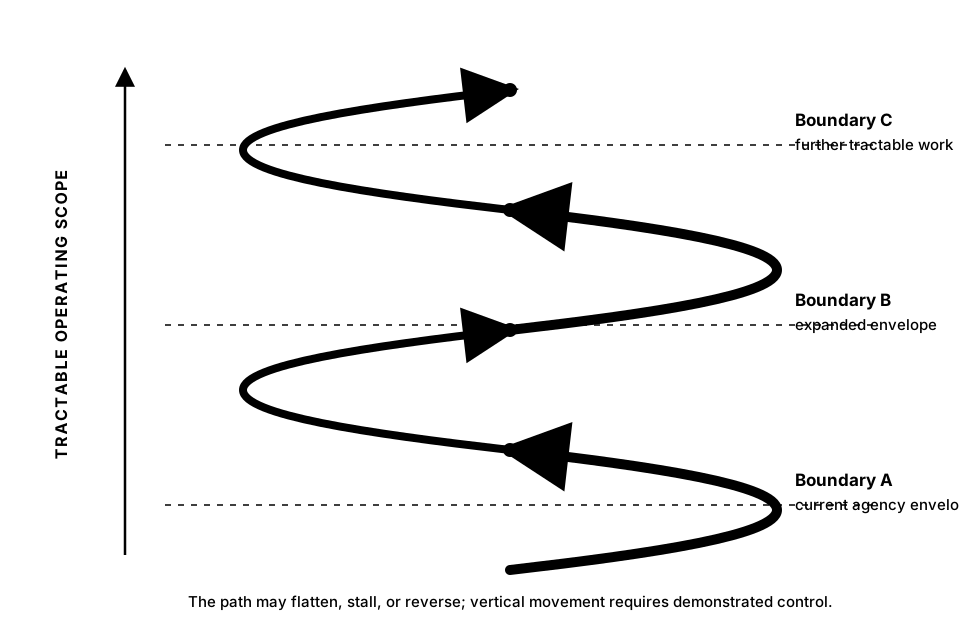
In the patch-drafting example, evidence may justify letting the system edit a branch within narrow limits, with a person approving the merge. If learning makes another class of edits economical to delegate within accepted error limits, that repeated expansion illustrates Helix.
What carries forward depends on shared task structure, interfaces, and failure modes. Incident histories and operator knowledge can guide the next deployment; existing controls remain useful where their assumptions still hold. New permissions, longer action sequences, or changed tools require fresh evaluation and may force a rebuild. In the patch example, compatibility tests may still work while branch editing creates new requirements for managing state changes and recovery.
Retained learning reduces the marginal burden only when reuse saves more effort than adaptation, revalidation, and added oversight consume. Expansion can also make earlier operating assets less useful. Both effects belong in the accounting.
Assumptions#
I would establish these entry conditions before testing expansion:
- Bounded tasks have measurable outcomes and a documented operating baseline.
- Local learning has produced tested improvements, and relevant behavior can be monitored.
- Someone has authority to change the operating boundary and a reason to pursue additional delegation.
- Candidate expansions, acceptance criteria, error budgets, and an observation period are specified in advance.
Reusability, lower marginal burden, and net value from expansion are outcomes to test. Stalled and abandoned attempts belong in the record alongside successful ones.
Boundary conditions#
The operating envelope should permit intervention, containment, and recovery appropriate to the consequences of error. Expensive or delayed evaluation, irreversible action, and weak accountability limit the settings in which the mechanism is tractable.
If expansion breaks an entry condition, that reveals a practical limit. Narrowing the agency envelope can be the right response. Persistent difficulty establishing these conditions would limit broader diffusion.
Observable precursors#
I would look for these observations across selected workflows:
- Scope-adjusted reliability:
- The envelope expands within the previously stated error budget, with incidents assessed by severity, exposure, task mix, and observation period. Changes to risk tolerance are recorded separately.
- Visible supervision:
- Routine correction and exception handling are visible, both in total and per comparable outcome. Added work can justify greater total supervision.
- Reusable controls:
- The marginal time and cost of bringing comparable work inside acceptable bounds decline through retained controls and operating knowledge.
- Durable learning:
- Incidents become evaluations, policy changes, tool changes, or process changes whose effects persist.
- Boundary change:
- Organizations entrust additional work or authority on the basis of measured performance and net value after full costs.
Keep task mix, model changes, and human effort visible when comparing deployments, so we can tell where the gains came from. A broad structural transition requires repeated evidence across organizations and operating environments.
Failure modes#
Helix may stall, reverse, or fragment through:
- Automation theater: perceived progress substitutes for measured reliability.
- Compounding error and control debt: scope expands while rollback, attribution, monitoring, and incident response fall behind.
- Fragmentation: incompatible tool and evaluation surfaces keep reliability local and expensive.
- Value failure: gains disappear after integration, supervision, infrastructure, and failure costs.
- Overreach: open-ended agency is attempted where bounded workflows were required.